
Tomohiko Okamoto
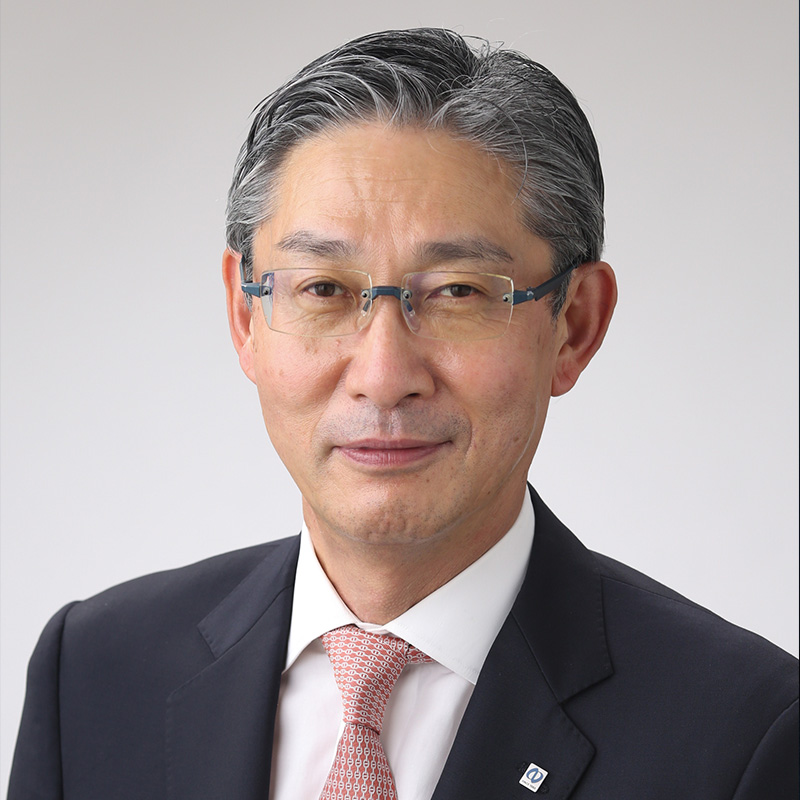
My name is Tomohiko Okamoto. I was born on April 8, 1960. I am the 16th president of Nabeya
Mr Tomohiko OKAMOTO, you are one of the Japanese members of the Henokiens Association. Could you please introduce yourself to our readers?
> T.O. : My name is Tomohiko Okamoto. I was born on April 8, 1960. I am the 16th president of Nabeya Co., Ltd.
My family began its foundry business in Gifu in 1560. My father, who is 96, is the 15th president of the family business and has inherited the name "Taemon" from the former president.
I joined the family through marriage. After working for a different company for five years, I joined Nabeya at 29 and was appointed president at 35.
Can you present your company and its activities?
> T.O. : Our company has a long history. The first foundry was established in Gifu in 1560 by Iyemon Okamoto, the head of our family. Our family was granted the title of "Imonoshi" (an official foundry master) by the Japanese imperial court, and has operated its foundry business ever since. Until the 18th century, our main products were temple bells and Buddhist ritual implements. From the 19th century onward, our main products changed to household items such as pots, kettles and irons, and casting products for industrial machinery.
Today, Nabeya manufactures industrial components such as jigs for machining, leveling jacks for equipment installation, and vibration-isolation products. We have 5 group companies including Nabeya. These companies operate casting business, precision machining, and specialized surface treatment for semiconductor manufacturing equipment.
There are 600 employees across the group companies.
What have been the outstanding events for your company in recent years?
> T.O. : In 2020, we held commemorative events to celebrate the 460th anniversary of our founding. In June 2022, we announced our commitment to the Sustainable Development Goals (SDGs), and in August we established a holding company overseeing the management of group companies including Nabeya.
In August 2025, under the guidance of the holding company, we created a medium-term management plan and announced the "10 Billion Yen Sales Declaration". This declaration set goals not only to expand our business, but also to accelerate our globalization and strengthen our organizational capabilities.
Could you give us some indications about your major projects in the medium or long term?
> T.O. : We aim to achieve annual sales of 5.4 billion yen by 2030 and 10 billion yen by 2035. This goal is not just about increasing sales. By increasing the number of high-value-added products and expanding our sales in global markets, we also aim to improve our employees' quality of life, both financially and emotionally.
How can you explain the longevity of your company?
> T.O. : I believe there are three reasons. First, we have adapted to the changing times. We have changed our products according to the customers' needs in each era, while also advancing our manufacturing technologies. Starting with casting production, we developed expertise in precision machining and measurement processes. Second, business stability. We have prioritized stable management over aggressive expansion, even when opportunities for sales growth arose. Finally, we have always valued our employees. A company cannot thrive through the efforts of its leader alone; we have built our business with the support of dedicated and trusted employees.
Could you say that this extraordinary longevity is an asset in your customer relations?
> T.O. : Yes. I believe one strength of a long-established company is that the trust built over generations creates opportunities for future business. Our customers see us as a "trusted partner for the future".
Being part of a long-established company also gives our employees a sense of pride. As a way of expressing our pride in our heritage as Imonoshi, we still make temple bells using traditional methods. We have delivered our temple bells to famous Japanese temples such as Shibamata Taishakuten in Katsushika, Tokyo, and Osu Kannon in Nagoya. Making them demonstrates our commitment to continuous skill development.
Do the traditional values guiding the firm constitute an advantage as regards research and innovation?
> T.O. : Yes. We place importance on the concept of Fueki Ryuko: preserving the unchanging principles while adapting to the changing times.
What we preserve is our technical knowledge of clamping in products such as screws and vises, as well as our commitment to making products under our own brand. What we change are our products, how we manufacture and how we sell. This thinking enables us to approach new challenges.
What are the most important traps that your company must avoid in order not to lose its independence?
> T.O. : Our family has three family rules: "Stay out of politics", "Do not venture into the entertainment and leisure business" and "Value the bantō, the trusted senior managers who help run our family business". I believe these rules are important wisdom to protect our independence. It is also important not to overextend ourselves when opportunities for expansion arise. We avoid entering fields that require the scale and resources of large corporations.
Instead, we aim to become a market leader in niche industrial markets where we can use our specialized technical knowledge.
Is the handover of the firm to a family member governed by clearly established rules?
> T.O. : We don't have any specific rules. If there is a male descendant in the direct line, he becomes the successor. If there is no family member to take over the business, an adopted son is brought into the family and succeeds.
Is the new generation already working in the firm?
> T.O. : My son is already working for our company. He is responsible for sales marketing in the sales planning department. Previously, he worked at a video game software company, where he was involved in marketing for smartphone games. I hope that his experience will be helpful for our company's new challenges.
Do you have a message to communicate to all those who would like to start their own family business?
> T.O. : The strength of a family-owned business is that you can take a long-term view of your business.
I think three things are important. First is to keep the customer's perspective in mind. Second is to build the company together with your employees. Third is to have the courage to adapt to the times. Please continue taking on challenges while preserving what must not change.